
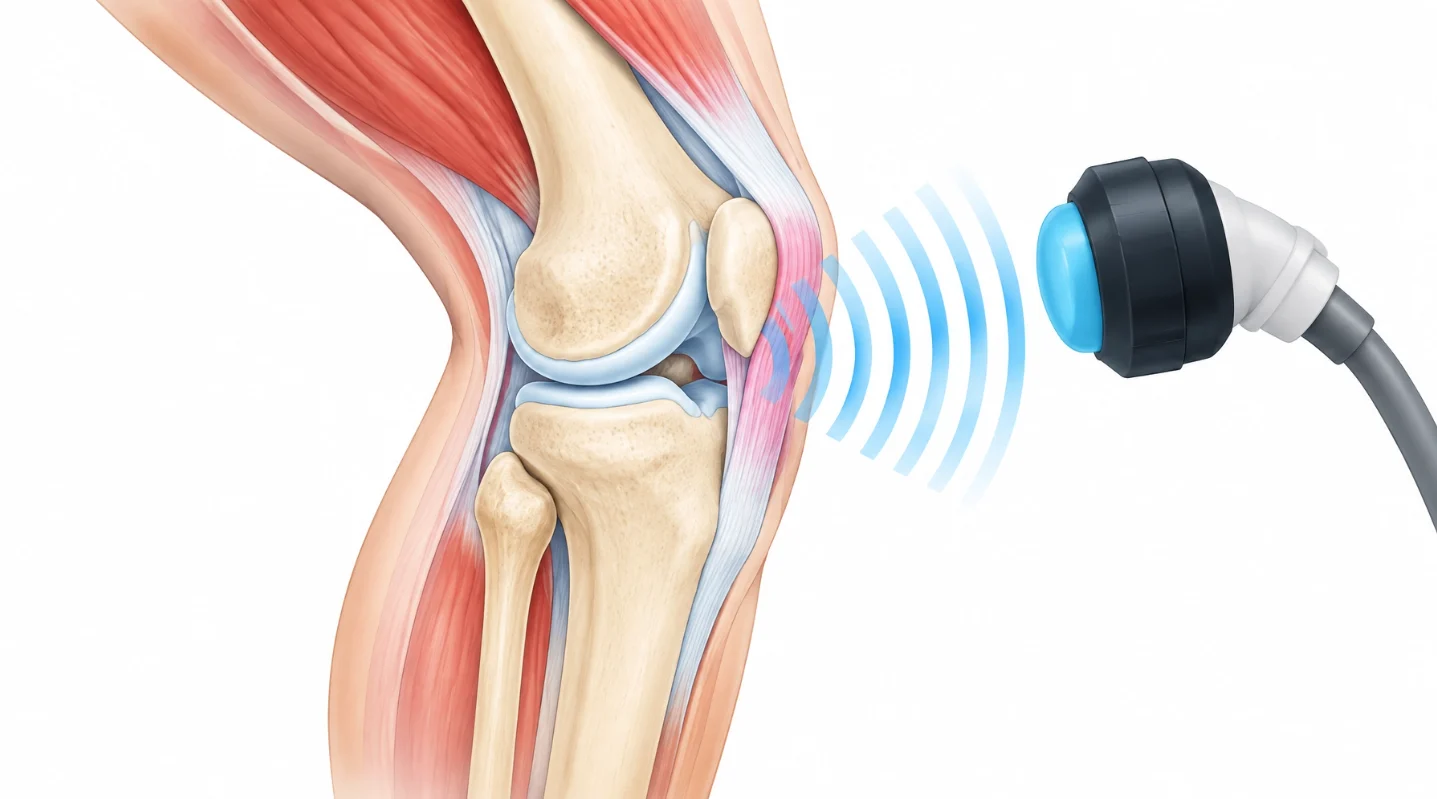
Shockwave for knee pain can be a useful non-surgical option for selected chronic knee conditions that have not improved with rest alone. In my experience treating patients in Evansville, one pattern I commonly see is a knee that has become less tolerant of normal activity because irritated tissue, restricted movement, weakness, or old injury-related changes have never been fully addressed.
A painful knee can affect nearly everything:
- Walking through the grocery store
- Going up or down stairs
- Standing from a chair
- Kneeling or squatting
- Exercising or golfing
- Working on your feet
- Playing with your children or grandchildren
At Lobacz Chiropractic, I evaluate the knee and the surrounding mechanics before deciding whether JointWave Shockwave Therapy belongs in a care plan. Shockwave for knee pain is not a guaranteed fix, and it is not appropriate for every diagnosis. However, for certain chronic tendon and soft-tissue problems, it may support the body’s healing response without injections or surgery.
What Shockwave for Knee Pain Actually Does
JointWave delivers focused acoustic energy through the skin and into targeted tissues. It is not an electrical shock, and it does not involve an incision.
The mechanical pressure waves may help:
- Stimulate local blood flow
- Support the formation of new small blood vessels
- Break up or remodel stubborn scar tissue
- Improve the environment around chronically irritated tissue
- Encourage a more active tissue-repair response
- Reduce pain sensitivity in some chronic conditions
The purpose is not to simply numb the knee. The purpose is to provide a mechanical stimulus that may help tissue become more responsive to healing and rehabilitation.
Research summarized by Mayo Clinic’s medical professionals resource describes shockwave therapy as an emerging treatment option for several musculoskeletal conditions. Results vary according to the diagnosis, severity, duration of symptoms, overall health, and how the patient responds.

7 Ways Shockwave Therapy May Help a Chronic Knee
1. It may support circulation in tissues that have been slow to heal
Some chronic tendon and soft-tissue problems do not behave like a fresh injury. They may remain irritated for months because the tissue has poor tolerance for normal loading and does not receive the same healing signals associated with an acute injury.
This therapy uses acoustic energy to create a controlled mechanical stimulus. In appropriate cases, that stimulus may support circulation and encourage the tissue to participate more effectively in the repair process.
2. It may help address stubborn scar tissue
Old injuries, repeated strain, and prolonged inflammation can contribute to scar tissue and tissue restrictions around the knee. These changes may affect how the knee moves and how comfortable it feels during stairs, squats, or walking.
JointWave is designed to apply focused pressure waves to selected areas. The goal is not to indiscriminately treat the entire knee, but to target tissue identified during the examination as potentially contributing to the problem.
3. It is non-invasive and does not require an incision
One reason patients ask about this treatment is that they want another option before considering injections or surgery. JointWave treatment is applied through the skin with a handheld applicator and coupling gel.
There are no surgical incisions, and patients do not need anesthesia for the treatment. Some people feel tapping, pressure, or temporary discomfort during application, especially when the area is sensitive. Intensity can be adjusted based on comfort and clinical findings.
4. It can work alongside hands-on chiropractic care
In my experience, a chronic knee problem rarely involves only one tissue or one movement. The hip, ankle, foot, pelvis, and spine can all influence how force travels through the lower extremity.
That is why shockwave for knee pain may be combined with chiropractic care when movement restrictions or mechanical issues are relevant. Hands-on care and JointWave serve different purposes:
- JointWave provides focused acoustic energy to selected tissues.
- Chiropractic care addresses relevant joint movement restrictions.
- Movement strategies help the knee gradually tolerate normal activity.
- Strengthening supports the muscles responsible for stability and control.
The combination is not automatic. It depends on what I find during the evaluation.
5. It may be useful when rest has stopped being enough
Rest can be helpful during an acute flare-up. However, simply avoiding activity does not always correct the reason a knee continues to hurt.
What I commonly see on examination is a cycle in which pain leads to less movement, less movement leads to weakness and stiffness, and the weaker knee becomes more irritated during basic activity. This treatment may be considered as one part of a broader plan designed to improve tissue tolerance and movement over time.
6. It allows treatment to be directed toward the suspected pain generator
“Knee pain” is a symptom, not a complete diagnosis. Pain may come from the joint, patellar tendon, quadriceps tendon, surrounding soft tissue, kneecap mechanics, arthritis-related changes, or a previous injury.
Before recommending this treatment, I want to understand:
- Where the pain is located
- Which movements reproduce it
- Whether swelling or stiffness is present
- How the knee, hip, ankle, and foot move together
- Whether there has been a previous injury
- What treatments have already been tried
- Whether the condition appears appropriate for conservative care
A targeted treatment is generally more useful than applying the same therapy to every painful knee.
7. It may provide an option before more invasive treatment
Some people are told that their next step must be an injection or knee surgery. In other cases, those options may eventually be appropriate. But not every chronic knee problem should move directly from discomfort to an invasive procedure without a careful evaluation of conservative choices.
Shockwave for knee pain may be considered for selected cases involving chronic tendon irritation, certain soft-tissue problems, or mild-to-moderate degenerative knee symptoms. It should not be presented as a way to rebuild severely damaged cartilage or eliminate the need for orthopedic care in every situation.
The goal is to determine what improvement is realistic and whether a non-surgical plan makes sense for your particular knee.

Who May Be a Good Candidate?
A person may be appropriate for an evaluation if they have:
- Knee pain lasting several weeks or longer
- Patellar tendon or other chronic tendon irritation
- Stiffness and discomfort associated with selected degenerative conditions
- Pain that repeatedly returns after rest
- Symptoms that limit stairs, walking, exercise, or work
- A desire to explore non-surgical care
- A willingness to combine treatment with appropriate movement and rehabilitation
A person may not be an appropriate candidate if the knee pain appears to involve a serious injury or a condition requiring immediate medical attention.
Additional evaluation may be needed for:
- Inability to bear weight
- A major injury or suspected fracture
- Significant sudden swelling
- A hot, red joint with fever
- Repeated true locking
- Severe instability
- An obvious deformity
- Rapidly worsening symptoms
In my experience, responsible care includes knowing when a patient needs imaging, an orthopedic opinion, or another type of medical evaluation.
What to Expect at Lobacz Chiropractic in Evansville
The first step is an examination. I want to understand what you are feeling, how the knee moves, and what activities are currently limited. Our knee pain treatment guide explains the broader evaluation and care process.
If your symptoms appear appropriate for JointWave, I will explain:
- Which tissues we are evaluating
- Why shockwave may or may not be appropriate
- What the treatment may feel like
- How it could fit with chiropractic care
- What movement or activity changes may be useful
- How we will monitor your response
Treatment plans vary. Some people may need a combination of JointWave, hands-on care, Class 4 MLS Laser Therapy, and progressive movement strategies. Others may need a different approach entirely.
You can learn more about the equipment and treatment process on our Shockwave Therapy service page and from JointWave’s official resource.
Shockwave Therapy Near Evansville, Newburgh, and the Tri-State
Lobacz Chiropractic serves patients from Evansville and surrounding communities, including Newburgh, Henderson, Owensboro, Boonville, and other areas of the Tri-State region.
If chronic knee pain is keeping you from walking comfortably, using stairs, exercising, or enjoying normal activities, an evaluation can help clarify what may be contributing to the problem. You do not have to assume that rest, injections, or surgery are your only choices, but you also deserve an honest assessment of whether conservative care is appropriate.
Frequently Asked Questions
Is shockwave for knee pain painful?
Shockwave for knee pain may feel uncomfortable while it is being applied, particularly over sensitive or chronically irritated tissue. The intensity can be adjusted, and treatment is generally brief. Temporary soreness, redness, or mild bruising may occur in some cases.
Does shockwave therapy work for arthritis?
Shockwave may be considered for selected people with mild-to-moderate degenerative knee symptoms, but it is not a guaranteed treatment and cannot be described as reversing advanced cartilage loss. The condition of the surrounding muscles, tendons, joint mechanics, and activity tolerance also matters.
How many treatments will I need?
The number of treatments depends on the condition, severity, tissue involved, and individual response. We do not promise a fixed outcome or use the same schedule for every patient. Your plan should be based on examination findings and progress.
Can I combine JointWave with chiropractic care?
Yes, JointWave may be combined with chiropractic care when both therapies are relevant to the findings. The purpose is to address different aspects of the problem rather than rely on one treatment for every knee condition.
What is the next step?
The next step is an evaluation to determine whether shockwave for knee pain is appropriate for your symptoms. You can schedule a consultation through the New Patient Calendar.
Take the Next Step Toward Better Knee Function
In my practice, I do not want to chase symptoms without asking why the knee continues to hurt. My mission is to identify the contributing factors, explain them clearly, and use appropriate hands-on care and advanced technology to support improved mobility without making promises that no treatment can guarantee.
If you are in Evansville, Newburgh, Henderson, Owensboro, or the surrounding Tri-State area, take the next step with an evaluation at Lobacz Chiropractic.
Lobacz Chiropractic
4910 Temple Ave
Evansville, IN 47715
Phone: 812-401-0994
Website: lobaczchiropractic.com
About the Author
Andrew Lobacz D.C. is the founder of Lobacz Chiropractic in Evansville, Indiana. He has treated patients with chronic joint and soft-tissue conditions since 2004 and focuses on identifying the underlying factors contributing to pain rather than simply masking symptoms. His approach combines hands-on chiropractic care with advanced, non-invasive technologies such as JointWave Shockwave Therapy and Class 4 MLS Laser Therapy when appropriate.
continue reading


